Lineage
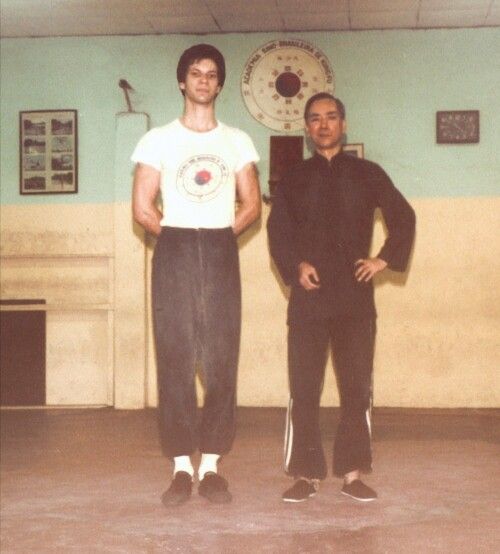
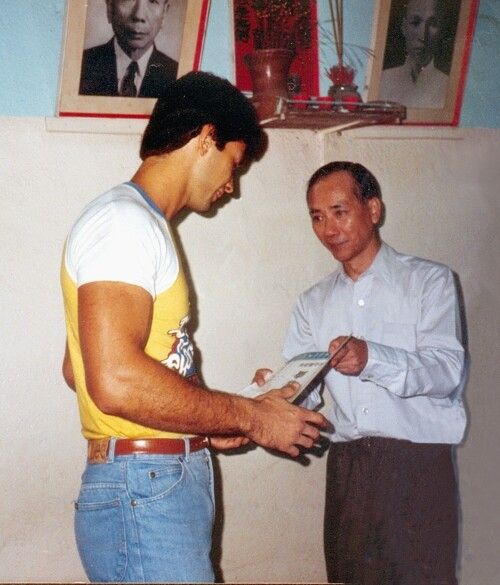
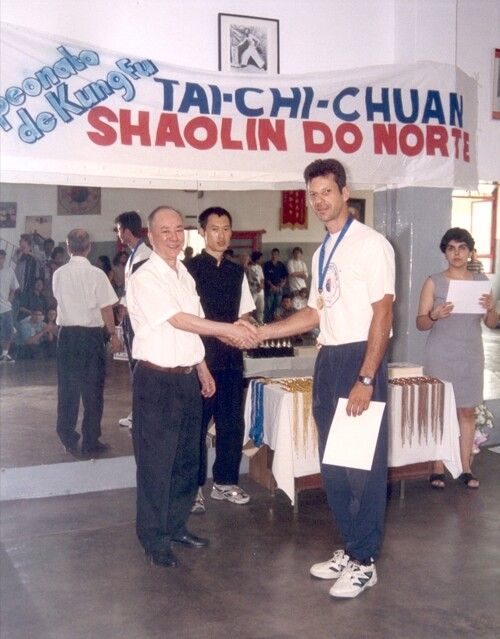
Grandmaster Chan Kowk Wai’s Northern Shaolin traces itself to the Shaolin Monastery. From the legend of the abbot Zhaoyuan, around 1650, to Chan there are nine generations; Gu Ruzhang and Yim Sheung Mo are the two before him. Chan brought the style to Brazil in 1960. Master Aang Willians learned from Chan’s disciple Gilmar Dantas, trained with Chan himself for about a decade, and was taught by Master Chen Ming Wah and by Grandmaster Chen Bing of Chenjiagou.
The tree, generation by generation
The tree runs from the oldest, at the top, to the newest, at the bottom. The left line is Northern Shaolin; the side lines are the other styles that entered the lineage. Tap or click a name to read its generation.
The origin
The Shaolin Monastery
The Shaolin Monastery (少林寺) stands on Song Mountain in Henan province and was founded in 495. Chan Kowk Wai’s Northern Shaolin traces its origin to it.
Tradition tells: the monk Bodhidharma taught the monks of the monastery. There is no historical record of it.
1st and 2nd generations
Zhaoyuan and Gan Fengchi
Tradition tells: around 1650 the abbot Zhaoyuan (朝元和尚, Chiu Jin) opened the monastery’s training, until then for monks only, to a layman: Gan Fengchi (甘鳳池). The English Wikipedia adds that Zhaoyuan was born Zhu Fu, of the Ming imperial family.
Gan Fengchi was a real person. The official history of the Qing dynasty (清史稿, chapter 505) records this fighter from Jiangning, today Nanjing, active between 1662 and 1735 and one of the “Eight Heroes of Jiangnan”. He was sentenced in 1729 and spared. The record names no Shaolin link, no teachers and no students.
3rd to 6th generations
Wan Bangcai and the Yan family
According to the lineage’s schools, Gan Fengchi taught Wan Bangcai (萬邦才, Man Pon Choi), who taught Yan Degong (嚴德功, Yin Ta Kung), who taught Yan Sanxing (嚴三省, Yin Sam Son), who taught Yan Jiwen (嚴機溫, Yin Kai Yun) in Shandong. The Academia Sino-Brasileira, Câmara Shaolin and Wikipedia give the same sequence. No record outside the schools has been found for these four masters.
The name of the last Yan varies. The schools write 嚴機溫 (Yan Jiwen). Chinese sources call Gu Ruzhang’s teacher in Shandong 嚴蘊齊 (Yan Yunqi), and the historian Benjamin Judkins calls him “Great Spear Yan”. He is probably one man with two names, but no source says so.
Counting Zhaoyuan as the 1st generation, Gu Ruzhang is the 7th, Yim Sheung Mo the 8th and Chan Kowk Wai the 9th.
7th generation
Gu Ruzhang
Gu Ruzhang (顧汝章, Ku Yu Cheong) was born in 1894 in Funing, Jiangsu province. His father, Gu Lizhi (顧利之), who owned an escort company, taught him tan tui (彈腿).
He then trained for more than ten years in Shandong with Yan, a friend of his father. He inherited the Ten Routes of Northern Shaolin, the weapons, the Small Golden Bell qigong (小金鐘) and Iron Palm. Sources differ on when he started: at 8, in 1911 or at 12.
In October 1928 he was among the top finishers of the first national examination of the Central Guoshu Institute (中央國術館) in Nanjing.
In 1929 he was one of the Five Northern Tigers (五虎下江南), the northern masters sent to Guangzhou to teach at the Liangguang Guoshu Institute. Wan Laisheng and Fu Zhensong were also in the group. In southern China, Gu’s style came to be called Northern Shaolin.
Gu also learned other styles and passed them on. In the taiji book he published in Guangzhou in 1936, he writes that he learned Yang-style taiji from Li Jinglin (李景林) and Hao-style taiji from Sun Lutang (孫祿堂). Sun Lutang was a master of xingyi and baguazhang. According to the schools, Li Jinglin also taught him baji, and Yu Zhensheng (于振聲) taught him cha quan.
Three of Gu’s students taught in Hong Kong: Ma Kim Fong (馬劍風), Yim Sheung Mo (嚴尚武) and Long Zixiang (龍子祥). Chan Kowk Wai learned from the first two. Gu died in 1952 in Guiyang.
8th generation
Yim Sheung Mo
Yim Sheung Mo (嚴尚武, Yan Shangwu, also written Yang Sheung Mo) was born in 1882 in Linxi, Sanjiang, Guangxi province. He was already a Hung Gar master when he challenged Gu Ruzhang to a friendly bout, lost, and became his disciple.
In Guangzhou he also learned from other masters. From Wan Laisheng (萬籟聲), another of the Five Northern Tigers, he learned liuhe quan (六合拳) and ziranmen (自然門). Wan had learned liuhe from Zhao Xinzhou (趙鑫洲), a student of Liu Dekuan (劉德寬), and ziranmen from Du Xinwu (杜心五). From Tam Sam (譚三), founder of Bak Sing Choy Li Fut, he learned that style.
Tradition tells: ziranmen began with a hermit known only as Master Xu (徐祖師), who taught it to Du Xinwu.
Tam Sam learned from Lui Charn (雷粲), of the Choy Li Fut founders’ line. Sources differ on who taught Lui Charn.
In the early 1950s Yim moved to Hong Kong, lived in Chan Kowk Wai’s family home and taught there. He made Chan heir to Northern Shaolin, martial qigong and healing massage. He died in 1971.
9th generation
Chan Kowk Wai’s teachers
Sources give 1936, 1935 or 1934 for Chan Kowk Wai’s birth; the site follows 1936. The tribute Master Aang Willians posted in January 2024 gives 3 April 1934.
Chan Kowk Wai began with Hung Sing Choy Li Fut (鴻勝蔡李佛) in his village in Taishan: from age 4 to 14 he trained with Chan Cheok Sing, the village teacher. In Hong Kong he continued with Jan Yiu Chiu (甄耀超, Yan You Chin; at Pak Shao Lin, Yin Yue Chui), a physician and the son of Jan Yim Cho (甄炎初). He also studied Chinese medicine with him.
Choy Li Fut comes from Chan Heung (陳享, 1806–1875) of King Mui, who combined what he learned from three teachers: his uncle Chan Yuen Wu, Li Yau San and the monk Choy Fook. The Futsan branch passed from Chan Heung to Jeung Yim (張炎), then to Chan Ngau Sing (陳吽盛), Ngaan Yiu Ting (顏耀庭) and Jan Yim Cho.
Tradition tells: the monk Choy Fook came from the Southern Shaolin Temple. Câmara Shaolin itself says the Southern Shaolin stories come from a Qing-dynasty novel.
The Academia Sino-Brasileira chart puts other names in the middle of this line: Chan Kwan Pak and Chan On Pak, Chan Heung’s sons. They ran the King Mui village branch. The Plum Blossom school, which has no link to Chan’s lineage, confirms Chan Ngau Sing as Jeung Yim’s successor in Futsan.
In Hong Kong, from 1949, Chan learned Lo Hon (羅漢拳) from his uncle Ma Kim Fong (馬劍風), a student of Gu Ruzhang. According to Câmara Shaolin, Ma had learned Lo Hon from Sun Yufeng (Sun Yok Fong).
Yim Sheung Mo introduced Chan to other masters. From 1949 to 1960 he studied Seven Star Mantis (七星螳螂拳) with Wong Hon Fan (黃漢勳) at Wong’s home. This line comes from Li Sanjian (李三箭, 1821–1891) and runs through Wang Rongsheng (王榮生), Fan Xudong (范旭東) and Luo Guangyu (羅光玉), who took the style to Shanghai in 1913 and to Hong Kong in 1930.
Tradition tells: Mantis was created by Wang Lang (王朗) and passed through the Taoist Shengxiao (升霄道人) before reaching Li Sanjian. Many scholars doubt that Wang Lang existed.
With Ching Jim Man (張占文), a teacher at the Hong Kong Jingwu association, Chan studied Eagle Claw (鷹爪翻子). The oldest link that can be traced is Liu Shijun (劉士俊, c. 1827–1910) of Xiong County, Hebei, and his student Liu Chengyou (劉成有). Only the Câmara Shaolin chart links Liu Chengyou to Ching Jim Man.
Tradition tells: Eagle Claw comes from the Song-dynasty general Yue Fei (岳飛) and from Lai Chun (李泉), and passed through the monks Dao Ji (道濟) and Fa Cheng (法成). Yue Fei’s biographies say nothing about martial arts.
Chan also learned baguazhang from Fu Wing Fai (傅永輝, 1911–1993), the son of Fu Zhensong (傅振嵩), another of the Five Northern Tigers.
After Chan
Aang Willians’s teachers
Master Aang Willians learned most of what he knows from Master Gilmar Dantas, a disciple of Chan Kowk Wai and the founder of Pak Shao Lin. He calls Gilmar “my kung fu father, in the Northern Shaolin family”.
He trained directly with Grandmaster Chan Kowk Wai for about a decade. About him he wrote that he “taught me so many things, in the years I trained with him”.
He also trained for about a year with Master Chen Ming Wah, Chan’s student since 1967.
In 2026 he was taught directly by Grandmaster Chen Bing, of the 20th generation of the Chen family, in Chenjiagou.
Master Chen Ming Wah
Chen Ming Wah was born in August 1954 in Taiwan; his parents came from Futian, in China. At 11 he came to Brazil, a 60-day voyage on a Dutch ship. In 1967 he began training with Grandmaster Chan Kowk Wai, who taught at weekends at the Chinese social centre in Liberdade, São Paulo.
He was one of the founders of the São Paulo State Kung Fu Federation. By telex and through the consulate, he made the contact with the Chinese body that ran the championships. That contact led to the invitation to the 1986 championship in Tianjin, China. There the Academia Sino-Brasileira was Brazil’s only official delegation: a team of ten, plus Chan himself.
He coined the word “Cati” for kung fu forms, so he no longer had to compare them to karate’s kata. “Cati” is made of the initials of the Portuguese words conjunto, artístico, treinos, íntegros (set, artistic, training, complete).
About Chan he said in a 2016 interview with Pak Shao Lin: “As the saying goes: ‘A teacher is a second father’.” And: “I only learned from him.”
Chen Ming Wah was Gilmar Dantas’s first teacher, from 1976. In 1979, when Chen left for China, Gilmar began training with Chan himself in Barra Funda, and received his Northern Shaolin diploma from him in March 1986.
Chen Ming Wah travelled among masters, taught them techniques and came back more often to those he judged worthy. There was no fixed schedule. Over about a year, he taught Master Aang Willians many techniques and qigong styles directly.
Master Chen Ming Wah died on 7 September 2026, aged 72.
Grandmaster Chen Bing
Chen Bing (陳炳) was born in March 1971 in Chenjiagou. He is the only son of Chen Yonghe (陳永和), the elder brother of Grandmasters Chen Xiaowang (陳小旺) and Chen Xiaoxing (陳小星), and a direct descendant of Chen Wangting. He began training at 6 with his two uncles and later became Chen Xiaowang’s formal disciple.
He represents the 20th generation of the Chen family and is the eldest of that generation’s “Seven Dragons” (七龍). He was national push-hands champion three times in the 70 kg class (1996, 1998 and 2000) and overall champion of the Henan provincial wushu championships five times in a row. He graduated in wushu from the Shanghai University of Sport in 1997.
In 2007 he founded the Chen Bing Taiji Academy in Chenjiagou and has led it since. China recognises him as a national-level representative inheritor of taijiquan’s intangible cultural heritage.
Master Robson Nobre, training partner
Robson Nobre was one of Master Aang Willians’s first training partners at Pak Shao Lin, and is his friend.
He was born in 1972 in Rio de Janeiro state. An Air Force sergeant, he came to São Paulo and began training with Master Gilmar Dantas in February 1994, at the Santana academy. He was São Paulo state, Brazilian and South American champion, in forms and in fighting; in 1999 he won the top fighting category of the South American Championship.
He received the Si-Fu title from Master Gilmar in December 2001 and the master title in July 2024, at Pak’s 40th-anniversary celebration. Today he teaches in São José dos Campos.
The grandmaster
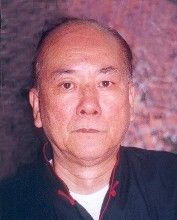
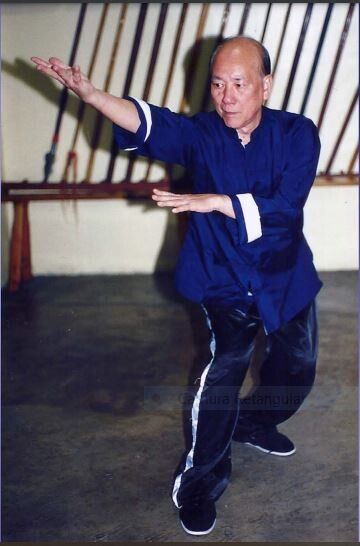
Chan Kowk Wai 陳國偉
He was born on 3 April 1936 in Taishan (台山), Guangdong province, in southern China.
In Hong Kong, from 1949, he learned Lo Hon from Ma Kim Fong (馬劍風). Then, through the 1950s until 1960, he trained with Yim Sheung Mo (嚴尚武), who taught in the house where Chan lived. Yim made him heir to Northern Shaolin, martial qigong and healing massage.
He taught five styles: Northern Shaolin, Yang-style taiji, baguazhang, xingyiquan and choy li fut.
He arrived in Brazil on 11 April 1960. He did not teach in his first years there; early in 1963 he began teaching students at home. In 1973 he founded the Academia Sino-Brasileira de Kung Fu in São Paulo, on Rua Vitorino Carmilo in Barra Funda; today the academy is on Rua João Moura in Pinheiros.
Chan came by ship, on a long and hard voyage, and brought box after box of weapons and training equipment so that he could teach properly in Brazil. He often lived on little money.
He co-founded the Chinese Social Centre in Liberdade and taught there for about 12 years. He taught for 7 years at the University of São Paulo and, from 1983, at Clube Pinheiros. At Pró-Vida, Dr Celso Charuri’s institution, he taught Northern Shaolin and tai chi from 1981.
Today Master Aang Willians teaches at the same Associação Pró Vida where the grandmaster taught.
He co-founded the São Paulo State Kung Fu Wu Shu Federation and was the first president of the Brazilian Kung Fu Wu Shu Confederation. In 1986 he led the Academia Sino-Brasileira delegation to the Tianjin championship in China, as Brazil’s only official delegation.
In September 2004, in Vancouver, the World Organization of Wu Shu & Kung Fu Masters awarded him the 10th degree.
He taught more than 60,000 students directly and personally trained more than a hundred teachers.
In 2010 he celebrated 50 years of teaching in Brazil, with Gilmar Dantas and Master Chen Ming Wah present.
Pak Shao Lin remembers him as the master who brought traditional Chinese kung fu to Brazil.
He died in São Paulo on 17 January 2022, of natural causes.
Chan’s family of schools today
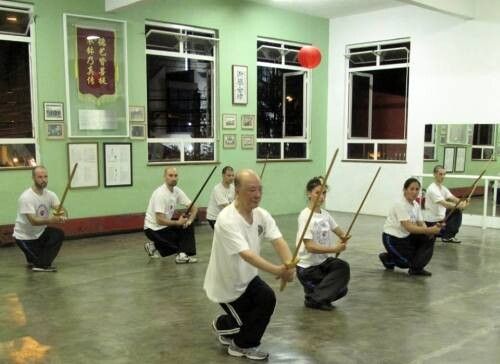
The schools of Chan’s lineage form the Sino-Brazilian Kung-Fu System: independent schools linked to the head school in São Paulo by a shared basic curriculum, by gatherings through the year and by an unwritten hierarchy.
A student who graduates as a teacher receives a votive plaque with 42 characters from their master.
In a 2023–24 survey of 13 teachers of the system, 12 had the portrait of Yim Sheung Mo (Yan Shangwu) in their training hall, 11 had the portrait of Gu Ruzhang and 10 had a photo of Chan Kowk Wai. The schools in the survey are in Campina Grande, Curitiba, Florianópolis, Lapa, Porto Alegre, Rio de Janeiro, São Leopoldo, São Paulo and Valinhos, in La Plata (Argentina) and in Coral Springs (United States).
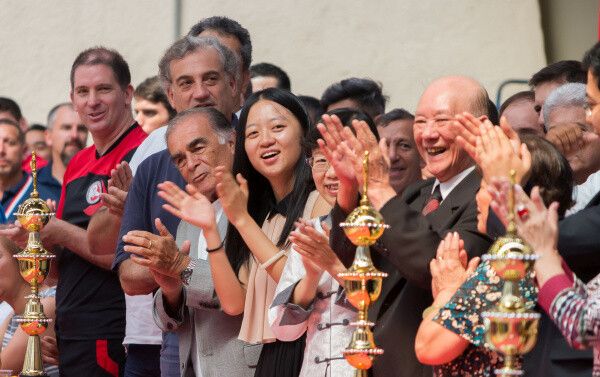
The schools hold ceremonies on each school’s anniversary, on Master Chan’s birthday and on other special days.
Chan designed the uniform most Northern Shaolin schools in Brazil wear: a printed white shirt with a crest on the front and the dragon embracing the Pa Kua on the back, and black trousers with a blue side stripe.
Kung Fu Day, 11 April, marks Chan’s arrival in Brazil in 1960 and is on São Paulo’s official calendar.
The Academia Sino-Brasileira de Kung Fu is still active in São Paulo.
Chan’s disciples and their students still meet to keep the grandmaster’s legacy alive. Master Aang Willians trains with them.
In January 2024, two years after Chan Kowk Wai’s death, he posted a tribute to “my kung fu great-grandfather”. He wrote that the students keep the grandmaster’s spirit alive when they bow at the altar, greet their kung fu brothers and sisters, practise every style he brought and live by 武德 (wu de, martial ethics).
Some of Chan’s disciples with schools of their own
- Lee Chung Deh: Porto Alegre, Florianópolis and Curitiba
- Roberto Baptista: Kung Fu Connection, Coral Springs, USA
- Rodrigo Martins: Academia Sino-Brasileira, Florianópolis
- Flavio Nahas: Académie Sino-Canadienne, Canada
Master Gilmar Dantas and Pak Shao Lin
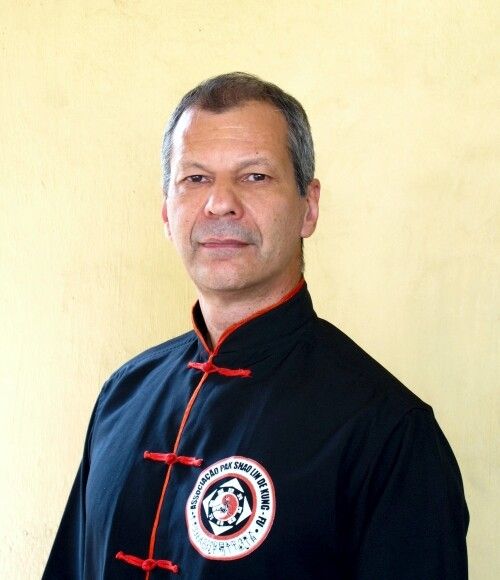
Gilmar Dantas 師父
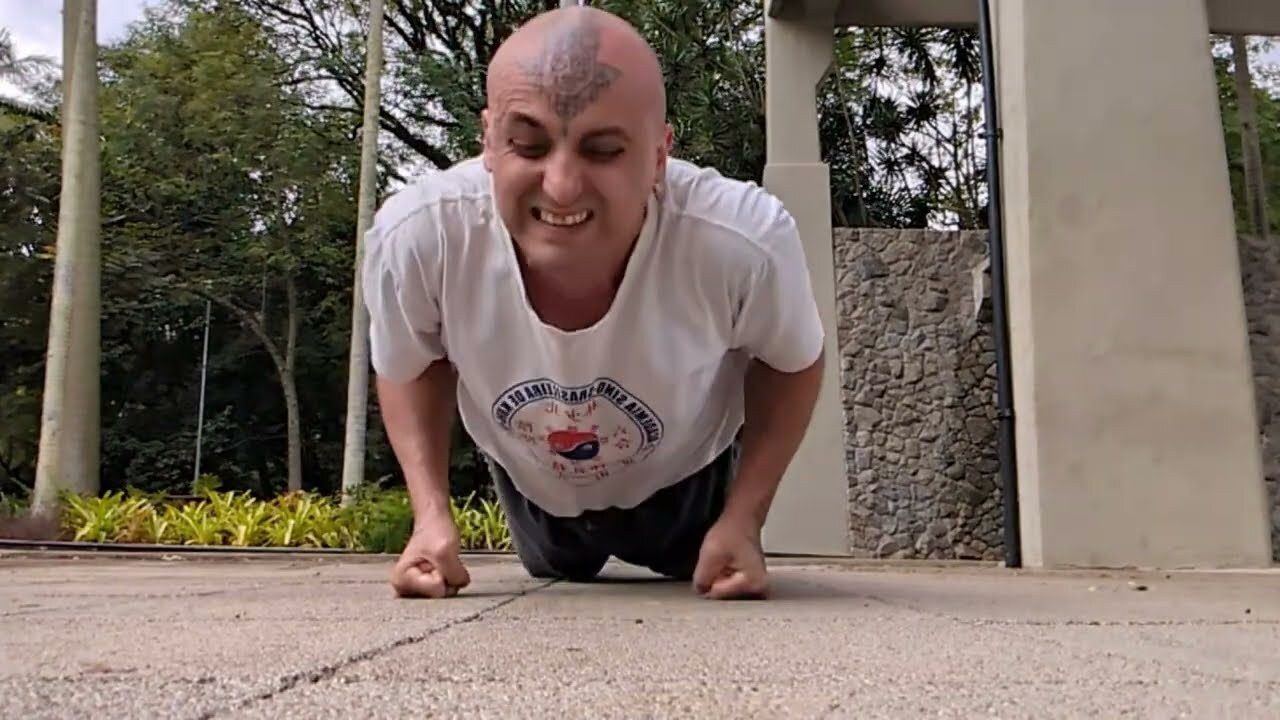
He founded the Pak Shao Lin Association in São Paulo in 1984. He is a direct disciple of Grandmaster Chan Kowk Wai.
He has more than 40 years in kung fu and has trained hundreds of students and many instructors.
Gilmar Dantas met Chan Kowk Wai in 1979 and began to train with him. In 1986 he received his diploma from the grandmaster.
The name Pak Shao Lin means “Little Forest of the North” and refers to the Shaolin Temple in Henan province.
Lembro que foram dias de muita força de vontade, pois o Kung Fu era praticamente desconhecido. Mas a paixão pela arte marcial e a certeza de que estávamos preservando algo valioso nos manteve firmes.
I remember those days took a lot of willpower, because kung fu was almost unknown. But our love for the martial art and the certainty that we were preserving something valuable kept us going.
Pak Shao Lin, 1976–2024
-
1976 · First steps
Gilmar Dantas starts training in martial arts and enters his first championships.
-
1979 · Meeting the master
Gilmar meets Grandmaster Chan Kowk Wai, who brought traditional Chinese kung fu to Brazil, and becomes his student.
-
1984 · The founding
On 1 July, Gilmar Dantas founds the Pak Shao Lin Kung Fu Association in São Paulo.
-
1986 · The diploma
Gilmar receives his diploma from Chan Kowk Wai.
-
1995 · Competitions
The Pak Shao Lin competition team enters official championships for the first time.
-
2001 · The first instructors
The school graduates its first class of instructors.
-
2004 · New schools
Pak Shao Lin opens new training centres.
-
2007 · Tribute from the FPKF
Gilmar Dantas receives a tribute from the São Paulo State Kung Fu Federation (FPKF).
-
2014–2018 · New instructors and São José dos Campos
New instructors graduate, and the São José dos Campos centre becomes established.
-
2024 · 40 years
Pak Shao Lin celebrates 40 years.
Photos from the school archive